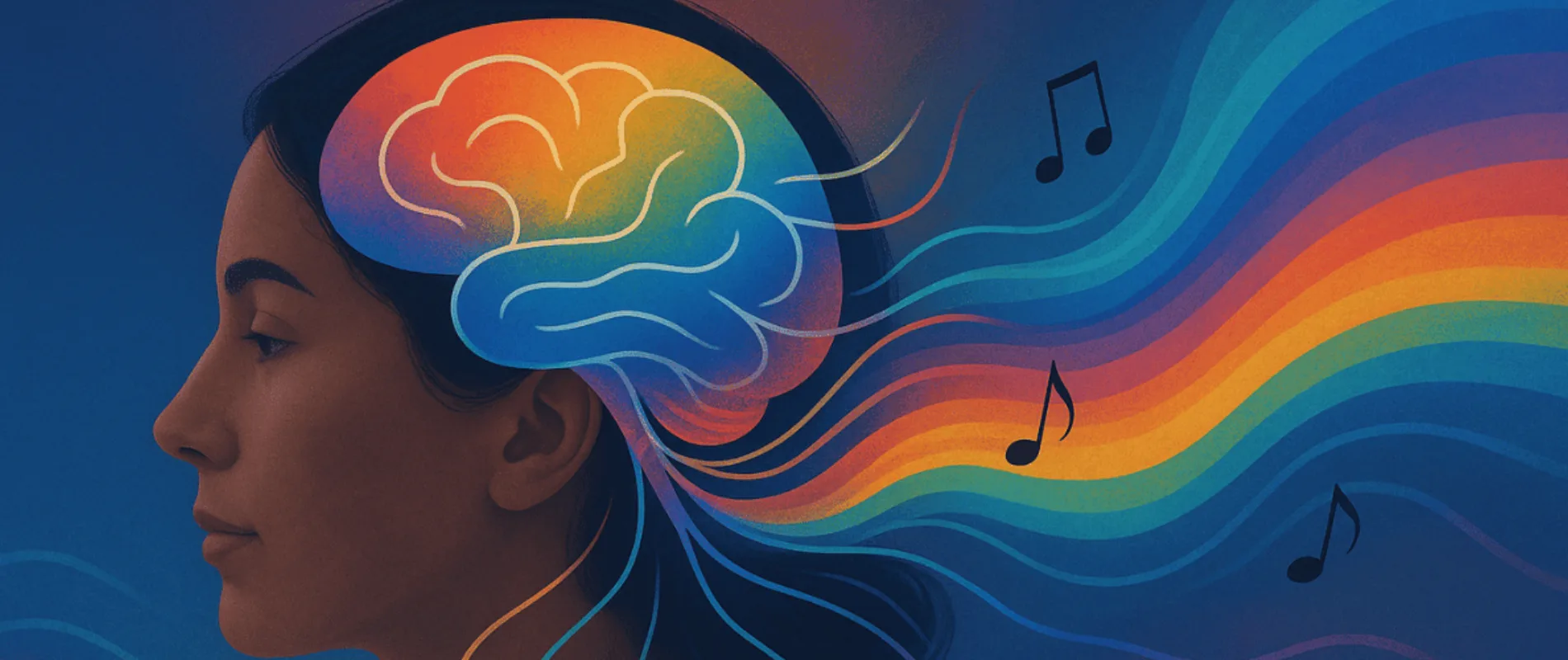
Do you experience synesthesia in your daily life?

20 Questions

3 minutes

Do colors, shapes, or spatial layouts show up automatically when you hear music, read, or think about dates and numbers? Our synesthesia test gives you an educational look at cross-sensory experiences in adulthood and helps you notice patterns in your sensory world without offering a diagnosis or replacing professional care.

Before you start, think about how your senses usually work together in daily life and how often you notice synesthesia-like patterns, not just on one unusual day. For each statement, choose one option from 1 (Disagree) to 5 (Agree).

Disagree

Neutral

Agree

1.

Hearing music often comes with an immediate sense of color or visual mood in my mind.

Disagree
Agree
2.

Many letters or numbers feel naturally linked to a particular color that seems obvious to me.

Disagree
Agree
3.

When I think about months of the year, they appear in a fixed layout in space, such as a line, arc, or circle.

Disagree
Agree
4.

These blended-sense experiences happen automatically rather than because I choose to imagine them.

Disagree
Agree
5.

These cross-sensory experiences have been present in my life for as long as I can remember.

Disagree
Agree
6.

Everyday sounds like traffic, typing, or a fan can trigger extra visual sensations for me.

Disagree
Agree
7.

People’s names or certain words reliably bring up a specific color, texture, or feeling of movement.

Disagree
Agree
8.

Number sequences, such as one to ten, appear arranged in a particular pattern in space when I picture them.

Disagree
Agree
9.

The links between a trigger and my extra sensation tend to stay the same over time.

Disagree
Agree
10.

My unusual sensory connections clearly influence how I remember information or events.

Disagree
Agree
11.

Different songs or pieces of music each seem to have their own stable color or visual “atmosphere” for me.

Disagree
Agree
12.

Reading or writing can bring up extra sensations such as color, taste, or texture attached to the symbols or words.

Disagree
Agree
13.

Dates, timelines, or calendars feel anchored to specific positions around me, as if they exist in a mental map.

Disagree
Agree
14.

My extra sensations feel vivid and real rather than like a vague metaphor or figure of speech.

Disagree
Agree
15.

I notice that my blended-sense experiences can make certain environments feel more intense or stimulating.

Disagree
Agree
16.

Hearing specific sounds or voices can create a sense of weight, temperature, or texture in my body.

Disagree
Agree
17.

Certain shapes, symbols, or logos consistently give me a sense of flavor, smell, or other added sensation.

Disagree
Agree
18.

I can easily describe where numbers, days, or months are located in the space around me.

Disagree
Agree
19.

My unusual sensory experiences feel like a natural, ongoing part of who I am.

Disagree
Agree
20.

I have wondered whether my sensory world is different from most people because of these consistent extra experiences.

Disagree
Agree

Disclaimer: TherapyDen’s online assessments are for informational and educational purposes only and are not medical or mental-health diagnoses. Do not start, change, or stop treatment based on results. Only a licensed clinician can diagnose. Not for children under 13.

We do not link your answers to your identity. Limited technical data may be collected for site functionality and analytics; manage choices in our Privacy Policy and Cookie Preferences, including “Do Not Sell or Share My Personal Information” where applicable. We do not use your responses for advertising or share them with advertisers.

If you are in crisis, call 988 (U.S.) or your local emergency number.

Methodology and limitations

This synesthesia self-screen was developed from core features described in the research: automatic, consistent cross-sensory experiences that often begin early in life and shape memory and perception. It is an educational tool for adults, not a diagnosis. Only a qualified clinician or researcher can formally assess synesthesia.

Sources

This test was informed by key work on synesthesia, including:

  • Cytowic RE and Eagleman DM, Wednesday Is Indigo Blue, MIT Press, 2009.
  • Ramachandran VS and Hubbard EM, Journal of Consciousness Studies, 2001.
  • Hubbard EM and Ramachandran VS, Neuron, 2005.
  • Eagleman Lab Synesthesia Battery and related peer reviewed publications.

Privacy note for the test

Your answers are used only to calculate and display your score on this educational tool. They are not used to diagnose you, advertise to you, or identify you personally. For more information on how TherapyDen handles data and privacy, please read https://www.therapyden.com/privacy-terms.

How does scoring work on this Synesthesia test

Rate each item from 1 to 5: Disagree, Slightly disagree, Not sure, Slightly agree, Agree. Add all 20 answers for a total between 20 and 100. Higher scores suggest more frequent and stable synesthesia like experiences. Results provide an educational snapshot, not a clinical diagnosis.

Synesthesia test FAQ: symptoms, types, and online screening

It can be strangely relieving to discover that the way you "see" music, numbers, or dates in your mind has a name. This FAQ is here to sit beside you as you think about your results on the synesthesia test and what they might mean. My goal is to give you clear, compassionate information so you can decide whether to simply stay curious or reach out to a professional who understands unusual sensory experiences.

What is synesthesia?

Synesthesia is a neurocognitive trait where one kind of input reliably and automatically brings up another sensation. When people first search what is synesthesia, they are often trying to describe long standing patterns like seeing colors when they hear sounds or picturing months in a fixed layout around their body. These experiences are usually present from childhood, feel effortless rather than imagined on purpose, and tend to stay remarkably consistent over time. For many folks, synesthesia feels less like a symptom and more like "just how my brain has always worked."

People often describe things like:

  • Hearing music and instantly sensing colors, textures, or movement
  • Seeing specific colors or shapes when reading letters, numbers, or names
  • Feeling that days, months, or numbers live on a mental map in space
  • Realizing these pairings quietly help them remember information or events

Synesthesia itself is not considered a mental illness or a sign that you are broken.

How does the TherapyDen test for synesthesia?

The TherapyDen screening is a brief self-report tool that explores patterns commonly described by adults with synesthesia. Each statement describes a type of cross-sensory experience, such as seeing colors with sounds, mapping numbers in space, or noticing extra sensations when you read or write. You're invited to rate how much each description fits your usual life, not just a single intense day.

Together, your answers form an educational profile, similar to a gentle synesthesia test online. It can highlight whether your experiences resemble those reported in research, including things like calendar-style spatial layouts or color-based responses to music. What it cannot do is diagnose synesthesia, rule out other conditions, or replace a full evaluation. Instead, it is a starting point you can bring into conversation with a therapist, psychologist, or researcher if you want to explore this more deeply.

How can I tell if I have synesthesia?

There is no single question that proves synesthesia, which is why people often end up typing do i have synesthesia into a search bar after years of private curiosity. Professionals look at several themes: are your pairings automatic rather than imagined on purpose, are they consistent over time, and did they show up early in life. Another clue is whether they feel woven into everyday activities like reading, listening to music, or thinking about dates.

You can start by gently observing your own patterns. Notice whether specific songs always carry the same "color," whether letters or numbers feel tied to particular shades, or whether timelines live in a stable mental space around you. Some people keep a small journal to see if their associations stay the same over weeks and months. Online tools like this test are helpful for reflection, but if your curiosity or worry grows, a clinician who understands sensory processing can look at your full history and help you sort through what you are experiencing.

Is synesthesia linked to high IQ?

Stories about famous artists and musicians sometimes give the impression that synesthesia automatically comes with exceptional intelligence. Research is more careful. Some people notice that their unusual sensory links seem to support memory, creativity, or pattern recognition, while others simply feel "average" and live very ordinary lives. A highly synesthetic brain is not automatically more intelligent, and having no synesthesia does not say anything negative about your abilities.

IQ, creativity, and synesthesia overlap in complex ways, and each person's profile is unique. If you are curious about your cognitive strengths, formal testing with a psychologist or neuropsychologist will give you a clearer picture than any self-screen for sensory traits can provide.

Is synesthesia a form of autism?

Synesthesia and autism are distinct, even though they can occasionally coexist in the same person. Synesthesia is about how senses are cross linked so that one input reliably triggers another sensation. Autism is a broader neurodevelopmental condition that affects social communication, flexibility, and sensory processing. Some autistic people describe vivid cross-sensory experiences, and some people with synesthesia relate to traits of neurodivergence, but one does not automatically imply the other.

People sometimes search for synesthesia disorder and worry that their experiences signal something serious. Current research suggests that synesthesia on its own is not classified as a disorder. If you are wondering about autism or any other diagnosis, it is important to talk with a clinician who can look at your whole story, not just your sensory world, and offer a thoughtful evaluation.

What is the rarest type of synesthesia?

There is no universally agreed upon ranking of "rarest" synesthesia, because many people never come forward and definitions vary across studies. That said, some forms do seem less common in research and clinical reports. Examples include tasting specific flavors when hearing words, feeling another person's touch inside your own body, or pain signals that blend with color or shape. These can be very real and sometimes intense experiences, even if they are less frequently described than color based or number based forms.

When you browse a types of synesthesia list, you may see examples like chromesthesia, calendar synesthesia, mirror-touch experiences, or emotion based pairings. Specialized tools such as a mirror touch synesthesia test or time-space questionnaires are mostly used in research settings rather than routine clinical care.

Who is most likely to have synesthesia?

Synesthesia appears across cultures, genders, and professions, but some patterns stand out. Researchers sometimes call a person with synesthesia a synesthete, and many synesthetes report that their experiences run in families. A parent might casually mention that music has always had color, or a grandparent might describe seeing the months wrapped around their body in a quiet, matter of fact way. These stories suggest a genetic contribution, even though the exact mechanisms are still being studied.

People who work in creative fields such as art, music, writing, or design may be more likely to notice and talk about their synesthetic experiences, in part because they pay close attention to imagery and sensation. At the same time, plenty of people with synesthesia live in technical, caregiving, or administrative roles and simply assumed everyone else perceived things the same way. If this test feels familiar, it may be a gentle invitation to learn more, compare your experiences with trusted resources, and, if you wish, bring these questions into therapy or medical care for a more personalized conversation.

QR Code

Do you experience synesthesia in your daily life?

QR Code